ChatGPT vs Gemini: The 2026 Comparison
ChatGPT vs Gemini in 2026: current models, pricing, context windows, and which AI assistant actually fits your specific workflow.

Talal Emran
Web Developer & Designer
Published
9 min read
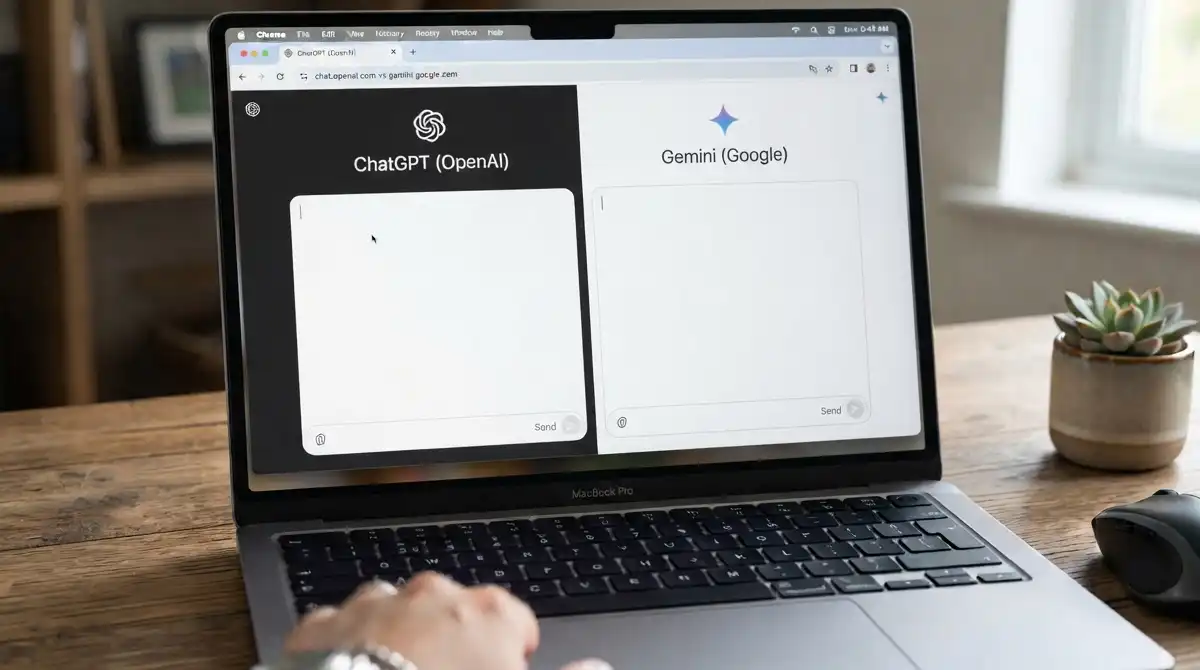
Both companies have shipped multiple flagship model generations since the start of 2026 alone — OpenAI moved from GPT-5.1 through GPT-5.6 to GPT-6 Astra, while Google pushed Gemini through 3.0, 3.1, and toward an announced-but-still-unreleased 3.5 Pro. If you compared these two assistants six months ago, that comparison is already outdated. This one reflects where things actually stand as of mid-September 2026, with an explicit warning built in: expect this to shift again within months, not years.
This article breaks down what ChatGPT and Gemini each do well right now, where the real gaps are, and which one fits your specific use case rather than declaring a single universal winner — because on the current evidence, there genuinely isn’t one.
How We Evaluated This Comparison
Given how quickly both platforms are shipping new models, we prioritized the most recently published, cross-referenced comparisons rather than any single source, and we flag model version numbers explicitly rather than speaking generically about “ChatGPT” or “Gemini” as if they were static products. Where sources disagreed on exact benchmark scores, we note the disagreement rather than presenting one figure as settled fact.
Where Things Stand Right Now
As of mid-September 2026, ChatGPT’s default flagship is the GPT-5.6 family — Sol (flagship), Terra (balanced), and Luna (fast, cheapest) — with GPT-6 Astra having begun rolling out to top-tier users in early September. On the Gemini side, Gemini 3.1 Pro remains the paid flagship inside Google AI Pro, while Gemini 3.6 Flash serves as the free-tier default; Google’s next major release, Gemini 3.5 Pro, was announced at I/O in May 2026 with a 2-million-token context window but had still not shipped as of this comparison, having missed several announced release targets.
| Factor | ChatGPT | Gemini |
|---|---|---|
| Current flagship | GPT-5.6 Sol / GPT-6 Astra (rolling out) | Gemini 3.1 Pro |
| Free tier default | GPT-5.6 Luna | Gemini 3.6 Flash |
| Context window (API) | ~1.05M tokens | 1M tokens (2M announced for unreleased 3.5 Pro) |
| Consumer paid tier | Plus, ~$20–$28/month | Google AI Pro, ~$20/month |
| Top tier | Pro, $100–$200/month | Ultra, $99.99/month (cut from $249.99) |
| API pricing (flagship) | ~$5–$14 input / $30–$69 output per 1M tokens | ~$2 input / $12 output per 1M tokens |
Where ChatGPT Still Leads
Writing quality remains ChatGPT’s clearest, most consistently cited advantage. Independent comparisons describe its output as more natural, expressive, and adaptable across tones, with stronger narrative control and fewer hallucinations in open-ended creative writing — one head-to-head test specifically noted Gemini’s creative output leaning on stock AI phrasing that ChatGPT avoided.
Desktop and agentic capability is the other area where ChatGPT holds a real, structural edge. ChatGPT can operate a desktop directly through computer-use functionality, something Gemini does not currently offer, and GPT-5.6 Sol posted a state-of-the-art result on Terminal-Bench 2.1 — a benchmark specifically measuring real-world agentic task completion, not just conversational quality.
Memory is a smaller but genuinely practical difference: ChatGPT maintains persistent, cross-session memory, while Gemini’s memory is more limited and largely session-based — a real factor for anyone who wants an assistant that remembers context across separate conversations without re-explaining it each time.
Best for creative and long-form writing, and for agentic desktop tasks: ChatGPT, given its consistent edge in natural prose quality and its unique computer-use capability.
Where Gemini Still Leads
Multimodal understanding and context length are where Gemini’s advantage is least disputed across sources. Gemini processes images, video, and audio natively within a single model, and multiple comparisons specifically note it’s stronger than ChatGPT at understanding images, charts, and documents fed into a conversation — a meaningfully different skill than generating polished output, and one that matters more for analysis-heavy workflows than creative ones.
Pricing is the other consistent Gemini advantage, and it’s substantial rather than marginal. Gemini 3.1 Pro runs roughly $2 input / $12 output per million tokens, compared to $5–$14 input and $30–$69 output for ChatGPT’s top-tier models — meaning Gemini can cost a fifth to a quarter of ChatGPT’s flagship rate on the API, depending on which specific model tier you’re comparing.
Google Workspace integration rounds out Gemini’s case for a specific kind of user: deep, native connection to Search, Docs, Sheets, and Gmail gives Gemini a workflow advantage that has nothing to do with model intelligence and everything to do with where the work already happens for many business users.
“The old shorthand — ChatGPT is smarter, Gemini is cheaper — is now only half right. ChatGPT still leads on raw intelligence, but the two have drawn level on context, and Gemini keeps the price advantage.” — Aivy, 2026 ChatGPT vs Gemini analysis
Best for multimodal analysis, large-document processing, and cost-sensitive API use: Gemini, given its native multimodal handling, large context window, and meaningfully lower per-token pricing.
Coding: A Genuine Split Decision
This is the category where sources disagree most directly with each other, which is worth naming rather than glossing over. Some comparisons put ChatGPT ahead on coding — one cites GPT-5.4 scoring 71.7% on SWE-bench Verified against Gemini 3.1 Pro’s 63.8%, with meaningfully fewer errors. Others report the reverse, with Gemini 3.1 Pro leading the WebDev Arena coding leaderboard, built specifically with coding workflows in mind.
The likely explanation is that both companies have shipped multiple model updates within the measurement window these different studies used, and coding benchmark leadership has genuinely traded hands more than once through 2026. Treat any single “X wins coding” claim from either side with real skepticism until you’ve tested both against your own actual codebase and task types.
Best practice for coding-heavy use: test both directly on your specific stack and task types rather than trusting a single benchmark citation, given how frequently the coding-leadership claim has flipped between the two platforms this year.

Reasoning and Intelligence Benchmarks
By April 2026, independent tracking had the two platforms at near-parity on general intelligence — both scoring 57 on the Artificial Analysis Intelligence Index at that point in time. Since then, both companies have shipped further updates, and the gap has moved in both directions depending on which specific models are being compared and when.
On harder, memorization-resistant reasoning tests like ARC-AGI-2, results genuinely conflict across sources — some show Gemini ahead, others show ChatGPT’s newer models pulling back into the lead after a subsequent release. Given the pace of updates from both companies, this is one of the least stable claims in the entire comparison, and any “reasoning winner” declared today should be treated as a snapshot, not a durable fact.
Choosing Between Them
- You do a lot of creative or long-form writing: ChatGPT, for consistently more natural prose and better instruction-following on nuanced creative tasks.
- You work heavily with images, video, audio, or large documents: Gemini, for native multimodal handling and its large context window.
- You need an assistant to operate your actual desktop or perform agentic tasks: ChatGPT, currently the only one of the two with genuine computer-use capability.
- You’re building on the API and cost per token matters: Gemini, given its consistently lower pricing across comparable model tiers.
- You already live inside Google Workspace: Gemini, for the native integration advantage that has nothing to do with model quality and everything to do with where your work already happens.
- You want persistent memory across separate conversations: ChatGPT, which currently offers more robust cross-session memory than Gemini’s more limited, session-based approach.
Where This Comparison Has Limits
A few honest caveats matter more here than in almost any other comparison on this site, given how fast this specific space moves.
- Every specific model name in this article will likely be outdated within months. Both companies have shipped multiple flagship generations within 2026 alone — treat the general patterns (writing vs. multimodal strength, pricing gap, memory difference) as more durable than any specific version number or benchmark score.
- Benchmark results genuinely conflict across sources, particularly on coding and hardest-tier reasoning tasks, likely because different studies capture different model versions mid-transition — don’t treat any single cited percentage as a stable, current fact.
- Consumer pricing has shifted meaningfully within the year. Google’s top Ultra tier was cut from $249.99 to $99.99/month during 2026, and OpenAI has adjusted its own tier pricing multiple times — verify current pricing directly before budgeting around any figure here.
- Neither platform is uniformly better across every task. The real answer depends on your specific workflow far more than it depends on which company currently holds the top spot on a given leaderboard.
The Bottom Line
There’s no single winner between ChatGPT and Gemini in 2026 — there’s a better fit depending on what you actually need. ChatGPT holds a real, consistent edge in creative writing quality, agentic desktop capability, and cross-session memory. Gemini holds an equally real edge in multimodal understanding, context window size, API pricing, and Google Workspace integration. Coding and raw reasoning benchmarks are too volatile and contested right now to declare a stable winner in either direction. Pick based on your actual workflow, and expect to revisit that choice as both companies keep shipping new models at a pace that makes any comparison a snapshot rather than a permanent verdict.
FAQ
Which is better for writing, ChatGPT or Gemini?
ChatGPT, consistently — independent comparisons describe its output as more natural and expressive with stronger narrative control, while Gemini’s creative writing has been noted for leaning on more generic AI phrasing.
Which AI is cheaper to use, ChatGPT or Gemini?
Gemini, meaningfully so on the API — its flagship pricing runs roughly $2 input / $12 output per million tokens, compared to $5–$14 input and $30–$69 output for ChatGPT’s top-tier models, depending on which specific tiers are compared.
Which AI is better for coding?
It’s genuinely contested — different benchmarks and different points in each company’s 2026 release cycle show different winners, so testing both directly against your own codebase is more reliable than trusting any single cited benchmark.
Does ChatGPT or Gemini have a bigger context window?
They’re close to parity — both sit around 1 million tokens on their current flagship API models, though Google’s announced but still-unreleased Gemini 3.5 Pro is expected to push to 2 million tokens once it ships.
Which AI is better for someone who already uses Google Workspace?
Gemini, given its native integration with Search, Docs, Sheets, and Gmail — a workflow advantage that comes from ecosystem fit rather than raw model capability.