The Purpose of Different Content Formats in Marketing
The purpose of different content formats for marketing in 2026 — what blogs, video, case studies, and podcasts each do best, mapped to the buyer journey.

Talal Emran
Web Developer & Designer
Published
9 min read
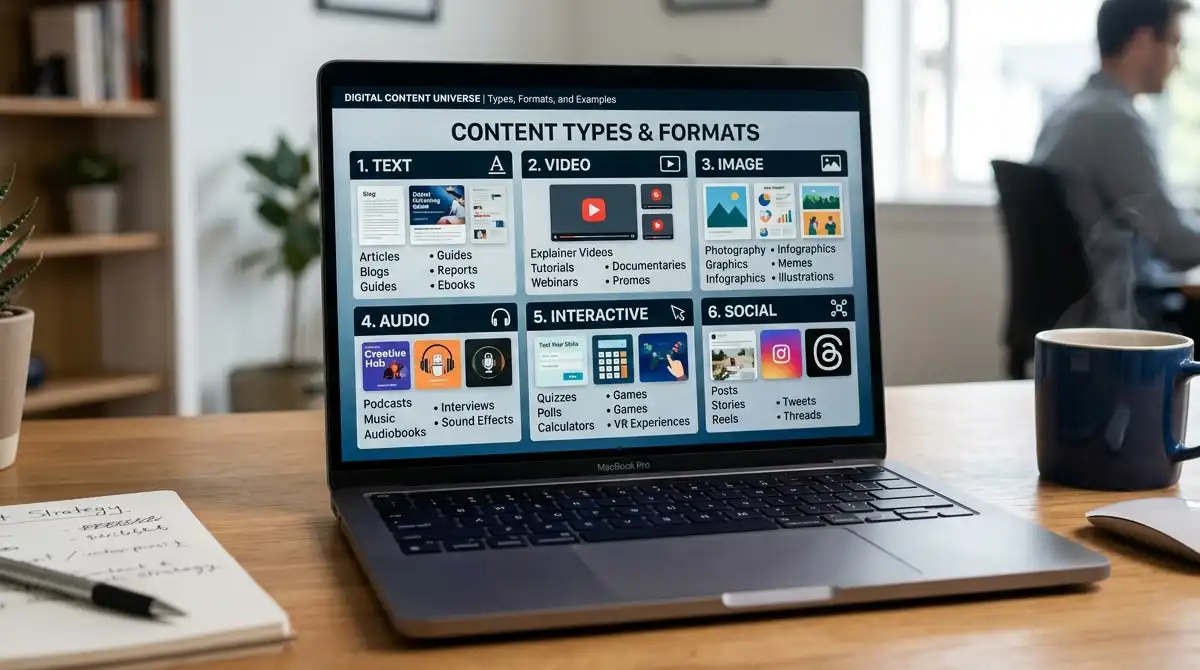
Case studies were the most popular content type among marketers in 2026, used by 41% of them, and 71% of B2B buyers have consulted one during a purchase. Yet short-form video sits at the top of most “best format” rankings. Both facts are true at the same time, which exposes the real mistake behind most weak content programs: treating “which format is best?” as a single question when each format was built to do a different job.
This guide breaks down what each major content format is actually for. It maps blogs, video, podcasts, case studies, whitepapers, webinars, and email to the buyer stage where each one earns its keep, so you can stop spreading effort evenly across formats and start assigning each one a specific role.
How We Evaluated This Guide
Format performance figures here come from 2026 industry reports, including HubSpot, Wyzowl, and Content Marketing Institute data as cited across multiple independent roundups. Usage and ROI statistics vary noticeably between sources, since surveys define “using a format” and “positive ROI” differently. Where sources disagree, we present a range or flag the difference rather than picking the most flattering number.
The Framework That Makes Format Choice Simple
The cleanest way to assign purpose to a format is the three-stage buyer funnel, and nearly every current guide uses the same structure. Top of funnel (TOFU) is awareness, middle of funnel (MOFU) is consideration, and bottom of funnel (BOFU) is decision. Each stage needs a different job done, so each needs a different format.

Awareness content should be broad, value-driven, and non-salesy. Consideration content demands the most depth, research, and personalization. Decision content exists to remove the last objection, usually by shifting persuasion from you to someone else.
Best for teams without a clear format strategy: before choosing any format, name the buyer stage the piece is meant to serve. A format with no assigned stage tends to get measured against the wrong goal and judged a failure.
Top of Funnel: Formats Built for Reach
Short-form video is the awareness workhorse. Short-form was used by 60% of marketers in 2025 according to HubSpot, making it the single most popular format, and it consistently ranks among the highest-ROI formats for reaching new audiences. Its purpose is attention and personality, not education: production runs roughly $50 to $500 per video, but it’s a poor fit for complex product education or enterprise B2B sales motions.
Blog posts serve awareness through search. They remain among the top five highest-ROI formats and among the top five that marketers plan to invest in for 2026. A blog’s job is to capture people already looking for an answer, and it compounds over time because a single well-ranked post keeps working without ongoing spend. Websites that blog regularly also have 434% more indexed pages than those without a blog, which widens the surface area for being found.
Infographics work at this stage for a narrower reason: they compress a statistic or process into something shareable, which makes them useful for earning backlinks and social distribution rather than for converting anyone directly.
Best for building initial audience: pair short-form video for reach with a blog for search. One recommendation that appears repeatedly for teams just starting out is to focus on only those two formats before adding anything else.
Middle of Funnel: Formats Built for Trust and Depth
Once someone knows you exist, the job changes from attention to evaluation. This stage demands the highest research and depth of any part of the funnel.
Case studies and whitepapers are the defining mid-to-late funnel formats, rated “very high” for lead-generation effectiveness in 2026 benchmark comparisons, with usage at roughly 61% and 58% of marketers respectively. A case study works because it moves the persuasion from your claim to a satisfied customer’s result, which is the most credible piece of content a company can produce.
Webinars and ebooks sit squarely in the consideration stage. Their purpose is to exchange substantial education for contact information, qualifying leads by their willingness to invest time.
Email newsletters and nurture sequences keep a prospect warm between touchpoints. Email’s role isn’t discovery. It’s retention of attention, delivering the right piece of consideration content at the right moment after someone has already raised their hand.
Podcasts occupy a distinct niche here. Branded podcasts can increase brand favourability by 14%, and 38% of listeners have purchased a product based on a podcast ad, but benchmark comparisons rate podcast lead-gen effectiveness as only low-to-medium. Their purpose is deepening trust and familiarity with an audience that’s already engaged, not generating new leads at scale.
“A single blog post can become a short video, a social media carousel, an email newsletter section, and a podcast talking point.” — Chit Chat Marketing, 2026 content types analysis
Best for B2B teams with longer sales cycles: invest disproportionately in this stage. It’s where case studies, whitepapers, and nurture email do the work that actually shortens the sales cycle.
Bottom of Funnel: Formats Built to Close
At the decision stage, the prospect is comparing you against a competitor and looking for proof. Two formats dominate here.
Case studies are the strongest closers. A well-written one showing a specific result for a specific client type can close deals no advertisement could, and case studies and user-generated content are consistently ranked as delivering the highest conversion impact at the bottom of the funnel.

Testimonial and case study videos carry the same persuasion into a more watchable format. They cost more to produce, roughly $500 to $3,000 per video, and they’re a poor fit for cold reach, but they’re among the most effective formats for sales pages and late-stage nurture. Testimonial videos are also reported as a top-ROI video format, with 47% of marketers citing positive returns.
Best for improving conversion on existing traffic: add case studies and testimonial video directly to the pages where people make the final decision, rather than creating more top-of-funnel content to feed a leaky bottom.
A Quick Reference: Format, Stage, and Purpose
| Format | Primary stage | Core purpose | Typical weakness |
|---|---|---|---|
| Short-form video | Awareness | Reach and brand personality | Poor for complex education |
| Blog posts | Awareness / consideration | Search capture, compounding traffic | Slow to rank |
| Infographics | Awareness | Shareability, backlinks | Rarely converts directly |
| Webinars / ebooks | Consideration | Lead qualification through education | High production effort |
| Consideration / retention | Nurturing and staying top of mind | Requires an existing list | |
| Podcasts | Consideration | Deepening trust with engaged audiences | Low direct lead generation |
| Case studies | Decision | Proof and objection removal | Needs real customer results |
| Testimonial video | Decision | Trust at the point of purchase | Higher cost per asset |
How the Formats Work Together
The most useful insight in current format research isn’t any single format’s ranking. It’s that formats chain together. Short-form video drives people to the blog, the blog earns newsletter subscribers, the newsletter nurtures them toward a case study, and the case study closes the deal.
This is why teams using a hub-and-spoke model, where one core asset is repurposed across formats, produce 4.7 times more content than single-format teams with only 1.8 times more budget, according to Wistia’s 2026 research. One long-form session, such as a podcast or webinar, can be turned into 15 or more short clips, which means format diversity doesn’t have to mean multiplying production cost.
Best for small teams: start from one substantial pillar asset, then derive the awareness, consideration, and decision formats from it instead of creating each from scratch.
Where This Framework Has Limits
A few honest caveats apply, since format advice is often stated with more certainty than the data supports.
- Usage statistics vary widely between sources. Blog usage appears as 38%, 74%, or 92% depending on the survey and how it defines the format, so treat any single adoption figure as one reading, not a settled fact.
- Funnel mapping is a simplification. Real buyers don’t move linearly. A prospect may read a case study before ever seeing a blog post, so formats are better treated as strong defaults than rigid rules.
- B2B and B2C weight formats differently. Video usage runs at 87% in B2C versus 58% in B2B in one 2026 comparison, and case studies matter far more in long-cycle B2B purchases than in impulse-driven consumer ones.
- ROI claims are mostly self-reported. Most “positive ROI” figures come from marketer surveys, not controlled measurement, so they indicate perceived value rather than proven causation.
The Bottom Line
Every content format has a job, and the mistake is asking one format to do all of them. Short-form video and blogs build awareness, case studies, whitepapers, webinars, and email carry prospects through consideration, and case studies and testimonial video close the decision. The strongest programs don’t pick a winner among formats. They assign each one to the buyer stage where it performs best, then repurpose a single core asset across all of them so the system stays affordable.
FAQ
What’s the best content format for marketing in 2026?
There isn’t one — short-form video leads on reach and ROI for awareness, while case studies lead on conversion at the decision stage. The right answer depends on which buyer stage you’re trying to serve.
Which content format is best for closing sales?
Case studies and testimonial or case study videos. They shift persuasion from your own claims to a customer’s results, which is why they consistently rank highest for conversion impact at the bottom of the funnel.
Are podcasts worth it for marketing?
For deepening trust with an engaged audience, yes — branded podcasts can lift brand favourability by 14% — but they rate low-to-medium for direct lead generation, so they work best alongside other formats rather than as a primary lead source.
How many content formats should a small team start with?
Two. Long-form blog content for search and lead generation, plus short-form video for awareness and social growth, then add consideration and decision formats as capacity allows.
How do I get more formats without more budget?
Use a hub-and-spoke approach: build one substantial pillar asset, such as a webinar or podcast episode, and repurpose it into short clips, newsletter sections, carousels, and blog content rather than producing each format independently.