How to Make Your 2026 Content Plan
How to make your 2026 content plan: goals, audit, pillars, AI rules, an editorial calendar, and a review loop, built on current CMI research.

Talal Emran
Web Developer & Designer
Published
9 min read
A plan only helps if you can act on it before the year ends, so start with the calendar. It’s mid-October 2026, which gives you about eleven weeks. That’s too short for a twelve-month plan, but it’s the right length for a Q4 sprint, and the process below works either way: use it to plan the rest of 2026 now, then roll the same framework forward into 2027 without starting over.
The research gives a reason to be careful about how you plan. The Content Marketing Institute’s 2026 B2B survey of 1,015 marketers found that 97% have a content strategy, yet only 12% rate their content marketing highly effective, and 47% rate it somewhat effective. Having a plan isn’t the differentiator. The quality of the plan, and what you do with it, is. This guide walks through eight steps that turn a topic list into a plan you can run.
How We Evaluated This Guide

Statistics come mainly from the Content Marketing Institute’s 2026 B2B research, which was fielded in mid-2025 and is largely North American and self-reported, plus HubSpot figures and several roundups. Some numbers come from vendors and are flagged. The step structure draws on the common pattern across current planning guides: decide the strategy first, then build the plan, then the calendar.
First, Separate Strategy, Plan, and Calendar
These three get confused constantly, and confusing them is expensive. CMI treats strategy as the business case, audience, brand story, operations, and channel choices. A plan turns that into tactics: which topics, formats, and channels. A calendar schedules those tactics into dates and owners.
A calendar without a strategy is just a list of dates. A strategy without a plan never ships. The steps below move in order from strategy to plan to calendar.
Step One: Set Two or Three Goals, Not Ten
Start with outcomes, not topics. Choose two or three goals tied to the business, such as leads, revenue, newsletter growth, or brand search, and attach a measurable target to each. Everything later in the plan should serve at least one of them, and anything that doesn’t is a candidate to cut.
This matters because planning without a measurable goal is how teams end up measuring engagement they can’t connect to results. Decide what success looks like before you write.
Best for a Q4 sprint: pick one primary goal for the last eleven weeks. A short window rewards focus.
Step Two: Audit What You Already Have
Before creating anything, find out what’s working. Export your existing content with traffic, conversions, and publish dates, then sort it into three groups: top performers, average content, and dead weight.
The audit pays off in two ways. Top performers show which topics and formats your audience responds to, and they’re candidates for updating and repurposing. Underperformers tell you what to stop making. It’s also the fastest source of “new” content, since refreshing a proven post is often cheaper than writing a new one.
Step Three: Define Audience Questions, Not Just Topics
A topic list says what you want to talk about. An audience-question list says what people need answered. The difference decides whether content gets found, since nearly 30% of marketers reported decreased search traffic as buyers turn to AI tools, according to HubSpot figures cited in a 2026 strategy guide. Content built around specific questions, with direct answers up front, is what both search engines and AI assistants extract.
Gather questions from support tickets, sales calls, search data, and community discussions. For each, note the buyer stage it serves, because that determines the format.
Step Four: Choose Pillars and Formats by Funnel Stage
Group your audience questions into three to five content pillars, which are broad themes your business can credibly own. Then assign formats to the buyer stage each serves: short-form video and blog posts for awareness, case studies, whitepapers, and email for consideration, and case studies and testimonial video for decision.
You can’t do everything, so choose formats you can sustain. If you can only produce one video and two articles a month well, plan exactly that, because consistency beats ambition on a calendar.
Original research is worth a slot if you can produce it. One 2026 compilation reports that marketers publishing original data see higher conversion rates (64%) and stronger SEO performance (61%), though that figure comes from a vendor roundup and is directional.
Step Five: Decide Your AI Rules Before You Start Producing
AI belongs in the plan as a defined part of the workflow, not an afterthought. CMI’s 2026 data shows 95% of B2B marketers use AI, and 87% of those using it for content creation report a productivity gain. But only about 39% report an actual performance improvement, which suggests speed isn’t the same as results.
Common AI uses cited in CMI’s statistics include brainstorming topics (62%), summarizing (53%), writing drafts (44%), and optimizing (41%). A sensible rule is to use AI for research, outlines, drafts, and variations, and to reserve human judgment for editorial standards, brand voice, fact-checking, and original expert input.
“The operational question has stopped being whether to adopt AI and become which steps to automate and which to ringfence for human judgement.” — Peak Digital, 2026 summary of CMI benchmarks
Write down who edits AI output and what must be verified before publishing. That one decision prevents most quality problems.
Step Six: Build a Calendar That Reflects Reality
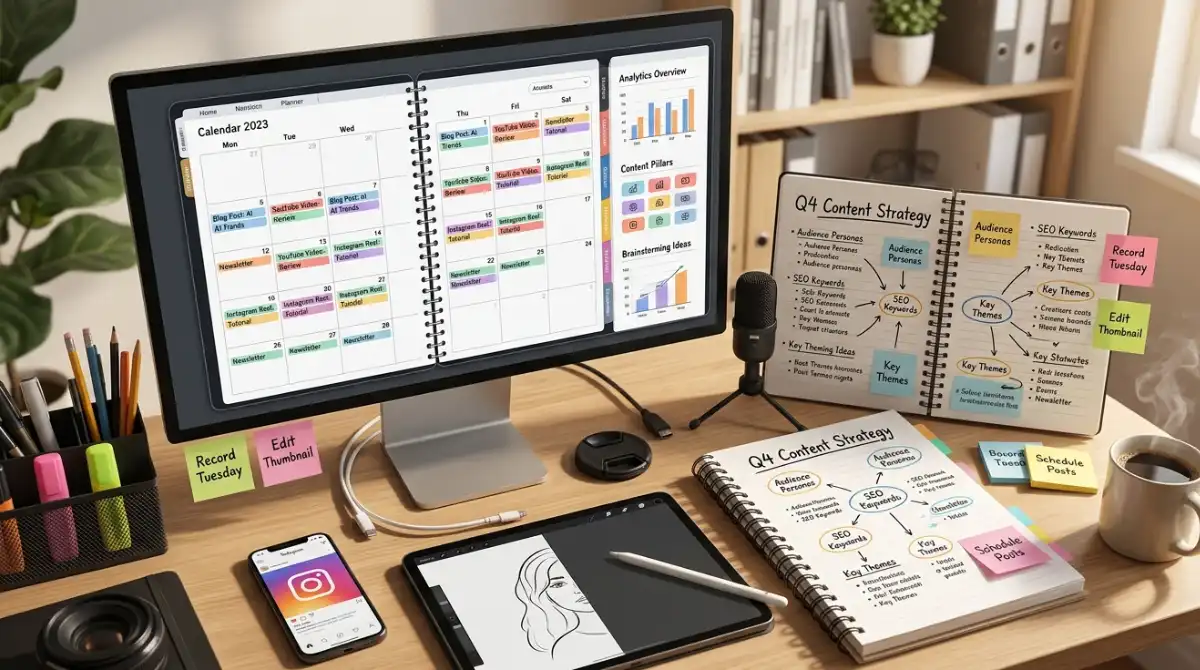
The calendar turns the plan into dates. Guides on this converge on tracking four things for every piece: the topic and target keyword, the content type and intended funnel stage, the owner and due date, and the distribution plan.
| Field | Why it matters |
|---|---|
| Topic and target keyword or question | Keeps each piece tied to a real audience need |
| Content type and funnel stage | Prevents imbalance across the funnel |
| Owner and due date | Creates accountability |
| Distribution plan | Ensures every piece has a reach plan, not just a publish date |
Set cadence from your actual capacity, not your hopes. A calendar that reflects reality means planning only what your team can produce well, then leaving a buffer for reactive content and slippage. For an eleven-week sprint, a realistic cadence might be one substantial pillar piece every two weeks, with repurposed pieces in between.

Best for small teams: plan one pillar asset per cycle and derive the rest from it, rather than originating every piece from scratch.
Step Seven: Plan Distribution and Repurposing From the Start
Publishing isn’t the finish line. For each pillar piece, decide in advance how it will be distributed: which social channels, whether it goes into the newsletter, and how it gets repurposed into other formats. A single substantial asset can become several short posts, an email section, and a talking point, which stretches the value of each piece of original work.
Building this into the calendar from the start also fixes a common failure, where strong content gets published once and then disappears. If you’ve already planned the repurposing, the second and third uses are scheduled, not remembered.
Step Eight: Set Metrics and a Review Rhythm
Close the loop with measurement. Choose a small set of metrics tied to your goals, such as qualified leads, conversions, organic traffic to key pages, and email growth, and decide how often you’ll review them. Quarterly reviews suit a content plan well: frequent enough to adjust, spaced enough for results to show.
Be patient with timing. Content marketing often takes many months to break even, so judge early weeks on leading indicators like publishing consistency, rankings movement, and engagement, not revenue alone. At each review, ask three questions: what performed, what didn’t, and what should change next quarter.
A One-Page Plan Template
If you want a minimal version, a single page can hold the whole plan:
- Goals: two or three, each with a number.
- Audience and top questions: the five to ten questions you’ll answer.
- Pillars: three to five themes you can own.
- Formats by funnel stage: only those you can sustain.
- AI rules: what AI does, what humans verify.
- Calendar: four fields per piece, built to your capacity.
- Distribution and repurposing: one line per pillar asset.
- Metrics and review dates: the numbers and the rhythm.
Where This Guide Falls Short
A few honest limitations apply.
- Most data is self-reported and B2B-weighted. CMI’s respondents are mostly North American B2B marketers, so the numbers may not fit a small B2C shop or a solo creator.
- A documented plan isn’t automatically a good one. CMI’s own earlier statistics showed only about 29% of marketers with a documented strategy rated it extremely or very effective, which is why this guide emphasizes review and iteration.
- Some figures come from vendor roundups. The original-research conversion and SEO figures, and several AI ROI claims in the wider literature, are directional and not independently verified.
- Time is short for 2026. With about eleven weeks left, treat this as a sprint and a template for 2027, not a full-year plan.
The Bottom Line
A good content plan is a short chain of decisions made in the right order: goals, an audit of what you have, audience questions, pillars and formats by funnel stage, clear rules for AI, a calendar built to your real capacity, a distribution plan, and a review rhythm. The research is clear that nearly everyone has a strategy and few call it highly effective, so the edge comes from execution and iteration, not from having a document. Build the plan small enough to run, then use the quarterly review to make the next one better.
FAQ
What’s the difference between a content strategy and a content plan?
Strategy covers the business case, audience, and channel choices. A plan turns that into specific topics, formats, and channels, and a calendar schedules them into dates and owners.
How far ahead should I plan content?
Quarterly planning with a rolling review works well, since it’s long enough to build momentum and short enough to adjust. With about eleven weeks left in 2026, plan a Q4 sprint and carry the framework into 2027.
Should I use AI in my content plan?
Yes, with rules. About 95% of B2B marketers use it, and most report faster production, but fewer than 4 in 10 report better performance, so define what AI drafts and what humans verify.
What should an editorial calendar include?
For each piece, the topic and target keyword, the content type and funnel stage, the owner and due date, and the distribution plan.
How do I know if my content plan is working?
Track a few metrics tied to your goals, such as qualified leads, conversions, and organic traffic, review them quarterly, and give the plan enough time, since content often takes many months to pay off.