Upwork vs Fiverr: Which Platform Actually Pays More
Upwork vs Fiverr in 2026: real fee structures, average project values, and which platform fits your freelance work — backed by current data.

Talal Emran
Web Developer & Designer
Published
9 min read
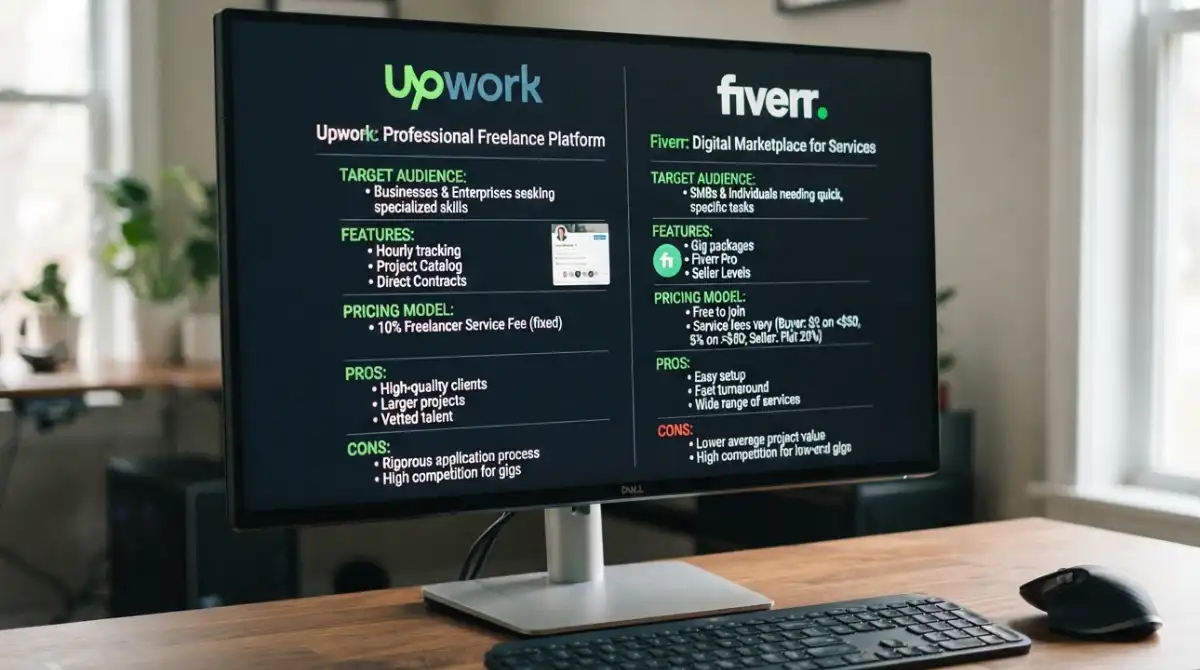
Upwork’s average project value sits around $800, with roughly 32% of 2026 jobs landing at $1,000 or more. Fiverr’s average order runs $50 to $500, with buyers spending about $342 a year on the platform. That gap alone tells you most of what you need to know before comparing fee percentages: these platforms were built for genuinely different kinds of work, and the “which one pays more” question depends entirely on which kind you do.
This comparison breaks down the real fee structures, the workflow differences that shape what actually gets you hired, and which platform fits your specific situation — whether you’re a beginner building a first client base or an agency scaling recurring contracts.
How We Evaluated This Comparison
Fee figures here reflect current 2026 platform policy where available, cross-checked against multiple independent breakdowns, since fee reporting on both platforms varies meaningfully depending on when a given source was published and which fee tier it’s describing. Where sources genuinely disagreed on a current structure, that’s flagged explicitly rather than presented as settled.
The Core Difference: Proposals vs. Listings
Everything else in this comparison flows from one structural choice. On Upwork, freelancers browse posted jobs and submit proposals — the client picks who they want to work with from a pool of applicants. On Fiverr, freelancers create standing “Gig” listings with fixed packages and pricing, and buyers browse and purchase directly, more like shopping a product catalog than posting a job.
That difference shapes everything downstream. Fiverr can feel easier to start on because buyers discover your listing directly with no bidding required. Upwork gives freelancers more control to target specific, well-matched work, but requires spending Connects — a paid credit system — to submit each proposal, which adds real cost to the process of finding work in the first place.
Fee Structures: Where the Real Confusion Lives
This is the single most inconsistently reported detail across current comparison guides, and it’s worth being direct about that rather than repeating a stale number with false confidence.
Fiverr’s structure is simple and consistent across every source: a flat 20% commission on every order and tip, with no tiering and no volume discount. Buyers additionally pay a service fee of roughly 5.5%, plus a small flat fee on orders under $100 — meaning a nominally $1,000 gig can cost the buyer more than $1,050 upfront once fees are added.
Upwork’s structure is reported two different ways depending on the source. Upwork’s own current guidance describes a variable 0–15% service fee, set per contract and influenced by factors like supply and demand, with most freelancers landing around 10%. Several independent comparison sites still describe an older tiered model — 20% on the first $500 billed to a client, 10% from $500 to $10,000, and 5% above that — which was Upwork’s structure in previous years. Given the discrepancy, treat Upwork’s official current-guidance figure (variable 0–15%, averaging near 10%) as the more reliable number, and confirm your specific rate directly in your account before relying on either figure for a pricing decision.
| Factor | Upwork | Fiverr |
|---|---|---|
| Freelancer fee | 0–15% variable (roughly 10% average) | Flat 20% on all earnings |
| Buyer/client fee | Contract initiation fee ($0.99–$14.99) plus up to ~10% | ~5.5% service fee plus $2–$3.50 on small orders |
| Cost to bid/list | Connects required per proposal (~$0.15 each) | Free to list a Gig |
| Payout holding period | Varies by payment method | 14 days standard (faster for top-tier sellers) |
| Subscription option | Freelancer Plus, $19.99/month | No equivalent subscription |
Best for freelancers optimizing for lower platform fees at scale: Upwork, since its 0–15% variable structure — averaging around 10% — consistently undercuts Fiverr’s flat 20% once you’re earning meaningful volume from repeat clients.
Best for freelancers who want zero cost to get discovered: Fiverr, since there’s no equivalent to Upwork’s paid Connects system standing between a freelancer and a potential buyer finding their listing.
Which Platform Actually Pays More
The honest answer is that they’re not really competing for the same work, which makes a direct “which pays more” comparison somewhat misleading on its own. Upwork skews toward long-term, high-value contracts in consulting, development, and data services — supported by 796,000 active clients spending over $4 billion annually, including roughly 145,000 clients who spend $5,000 or more per year. Fiverr’s earning model runs on packaged offers and order volume instead, which favors freelancers who can productize a fast, repeatable service rather than negotiate custom-scoped work.
“Upwork was built for agencies. Fiverr was built for gig buyers.” — GigRadar, 2026 platform analysis
That framing holds up in the income data too. Upwork reports a median income of $85,000 for full-time freelancers on the platform, with 31% earning $75,000 or more. Fiverr doesn’t publish an equivalent full-time median, largely because its seller base skews more toward part-time and secondary-income sellers than Upwork’s.
Best for freelancers targeting high-value, ongoing work: Upwork, provided you’re bidding selectively rather than spending Connects broadly across every posting that loosely fits your skills.
Best for freelancers with a genuinely productized service: Fiverr, where fixed scope and fast, repeatable delivery are what separates a profitable seller from one fighting the flat 20% fee on thin margins.
Which Is Easier to Start On
Fiverr wins clearly here. A Gig can be live within an hour of signing up, with no bidding process and no upfront cost to get listed. Upwork is harder to break into initially — new freelancers are competing against established profiles with review histories, and every proposal costs Connects regardless of whether it converts.
The trade-off flips once you have some track record. A sharp beginner on Upwork can win real, well-paying contracts through a strong proposal without needing hundreds of reviews first, since clients are evaluating a pitch, not just a star rating. Fiverr sellers, by contrast, often need to build up review volume before their listings gain enough visibility in Fiverr’s own search and recommendation system to compete with established Gigs.

A pattern worth knowing: many freelancers start on Fiverr specifically to build initial reviews and cash flow, then migrate toward Upwork as their rates and ambitions grow — using Fiverr as an on-ramp rather than a permanent home base.
Client Quality and Project Scope
Upwork favors custom, ongoing contracts — hourly billing, consultations, recurring work, and detailed proposals tailored to a specific client’s stated needs. Fiverr favors fixed-price, clearly defined services purchased more like a product than commissioned as a custom project.
That distinction matters most for freelancers doing complex or evolving work. A project that changes scope midway, requires back-and-forth revisions beyond what’s packaged into a Gig, or bills by the hour fits Upwork’s contract structure far better than Fiverr’s fixed-package model, where scope creep directly erodes the seller’s margin instead of being billed for.
How to Choose Between Them
- You’re brand new to freelancing with no portfolio yet: start on Fiverr to build initial reviews and cash flow quickly, with minimal upfront cost or bidding friction.
- You offer a fast, repeatable, clearly-scoped service: Fiverr’s packaged Gig format suits productized work far better than Upwork’s proposal-based system.
- You do custom, evolving, or high-value consulting-style work: Upwork’s proposal and contract system fits better, and its lower average fee structure pays off more as your rates climb.
- You want to minimize platform fees at real scale: Upwork’s roughly 10% average consistently beats Fiverr’s flat 20% once you’re earning meaningful, repeat-client volume.
- You want zero cost to get discovered: Fiverr, since there’s no equivalent to Upwork’s paid Connects system gating access to buyers.
Where This Comparison Falls Short
A few honest limitations belong here, since both platforms have loud advocates who tend to oversell their pick.
- Fee reporting for Upwork genuinely conflicts across current sources, as shown above — verify your actual rate directly in your account rather than relying on any single comparison article, including this one.
- Neither platform guarantees income at any level. High competition and inconsistent job or order flow are real risks on both platforms, and success depends heavily on niche, portfolio quality, and consistent effort, not the platform choice alone.
- Using both platforms simultaneously is common and often smart, which this comparison doesn’t fully capture by framing it as an either-or choice — many successful freelancers run Fiverr for volume and Upwork for higher-value contracts at the same time.
- Both platforms’ policies and fee structures change. Upwork’s own reported structure has shifted in recent years, and treating any specific number here as permanent is a mistake — confirm current terms before making a long-term platform decision.
The Bottom Line
There’s no single winner between Upwork and Fiverr — there’s a better fit depending on what you’re actually selling. Fiverr wins on ease of entry and zero-cost discovery, making it the stronger on-ramp for brand-new freelancers and productized service sellers. Upwork wins on long-term earning potential and lower fees at scale, making it the stronger platform for custom, high-value, or ongoing work once you have some track record behind you. Many experienced freelancers eventually use both rather than picking one permanently.
FAQ
Which platform has lower fees, Upwork or Fiverr?
Upwork, in most cases — its variable 0–15% fee averages around 10%, undercutting Fiverr’s flat 20% commission on every order, though Upwork’s older tiered fee structure is still cited by some sources, so it’s worth confirming your current rate directly.
Is Fiverr or Upwork better for beginners?
Fiverr is generally easier to start on, since a Gig can go live within an hour with no bidding cost, while Upwork requires spending paid Connects on proposals and competing against freelancers with existing review histories.
Can you make a full-time income on Fiverr?
Yes, particularly with a productized, repeatable service, but Fiverr doesn’t publish a full-time median income the way Upwork does — its seller base skews more toward part-time and secondary-income work.
Which platform is better for long-term or recurring client relationships?
Upwork, since it supports ongoing contracts, hourly billing, and recurring work directly, while Fiverr is built primarily around fixed-price, transactional Gig orders.
Should I use both Upwork and Fiverr at the same time?
Many experienced freelancers do — using Fiverr for volume and quick, productized orders while using Upwork for higher-value, longer-term contracts, rather than treating the choice as strictly either-or.